Australian dollar hits three-month high as inflation puts September rate hike back in play
OFX
The Australian dollar has climbed to a three-month high above US$0.718 after stronger-than-expected July inflation data revived expectations that the Reserve Bank of Australia (RBA) could raise interest rates later this month.
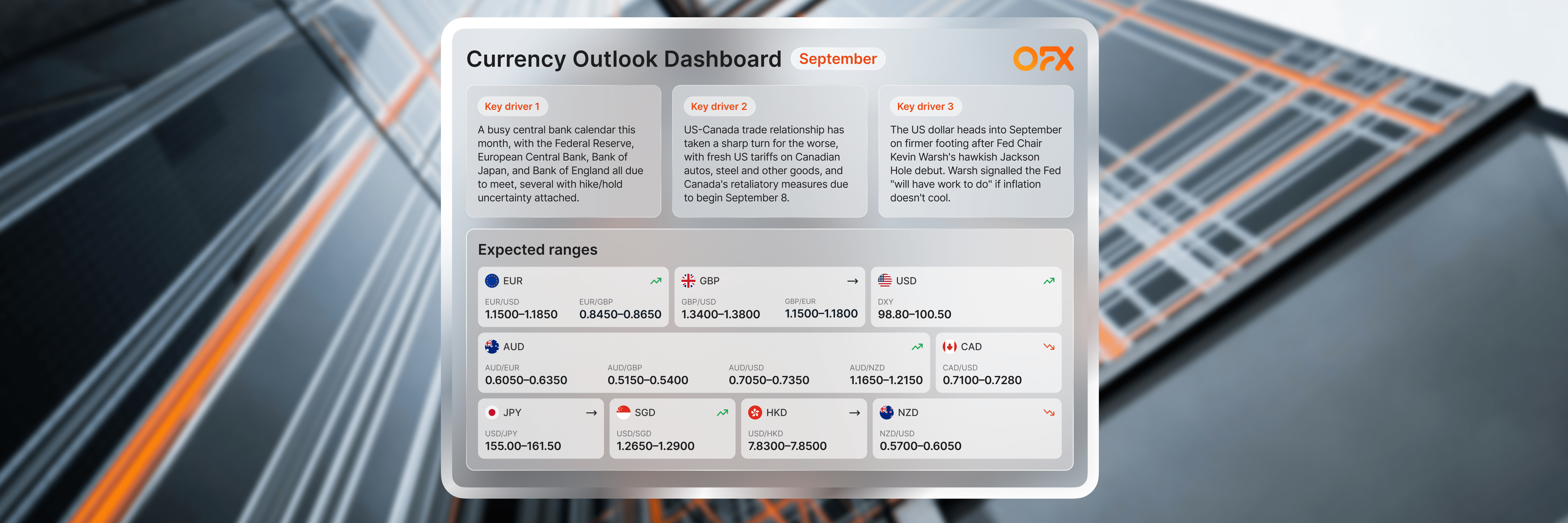
Australia’s inflation surprise comes as global currency markets head into a busy September, with the RBA, US Federal Reserve, European Central Bank, Bank of Japan and Bank of England all set to meet.
Currency markets are also watching the escalating US-Canada trade dispute, with Canada’s retaliatory tariffs due to take effect from 8 September.
“Australia’s inflation surprise has flipped the narrative for the RBA almost overnight,” said Michael Sorial, Associate Director of Client Management at OFX.
“Only a few weeks ago, expectations of further RBA tightening had faded following weaker jobs data. The latest inflation figures have put a September rate hike firmly back in the conversation.
“Importantly, price pressures are proving broader than just petrol, with housing and discretionary spending also contributing to the stronger result.
“For Australian businesses moving money internationally, the shift in rate expectations has already helped push the Australian dollar higher. With several major central banks meeting this month, we could see plenty more volatility ahead.”
Currency highlights for September
AUD | Australian dollar
The Australian dollar rose above US$0.718, reaching a three-month high after July inflation came in above expectations.
Headline inflation eased to 3.5% year-on-year but remained above the 3.2% market consensus. The RBA’s preferred trimmed mean measure held at 3.6%, also higher than expected.
The data prompted markets to reassess the chances of an RBA rate hike at its 29 September meeting, with AUD/USD moving towards its 2026 high of 0.7255.
A more hawkish RBA, combined with continued US dollar weakness, could push the Australian dollar towards its recent highs. However, renewed US dollar strength around the Federal Reserve’s September meeting could see AUD/USD retreat towards the low US$0.70s.
USD | US dollar
The US dollar has recovered from five-month lows, with markets reassessing the outlook for US interest rates following stronger inflation data and hawkish comments from Fed Chair Kevin Warsh.
The Dollar Index fell to a three-month low in August before recovering. Markets are now pricing a roughly 50–57% chance of a Fed rate hike at its 15–16 September meeting, while a rate hike by the end of the year is close to fully priced.
GBP | Sterling
Sterling reached a six-month high near US$1.365 in August, supported by broad US dollar weakness.
The Bank of England’s 17 September meeting will be the next key test for the pound, while the UK’s Autumn Budget on 28 October remains a source of fiscal uncertainty.
The Bank held rates at 3.75% in July, with markets also watching its plans for reducing its balance sheet.
EUR | Euro
The euro rose above US$1.16 at the end of August, reaching its highest level in three months.
EUR/USD climbed from the low US$1.15s to around US$1.167 by month-end, supported by US dollar weakness and improving eurozone economic data. The eurozone composite PMI rose to 52.1, its highest level since November.
The European Central Bank meets on 10 September, with markets currently expecting a 25-basis-point rate increase to 2.5%.
Also on watch
The New Zealand dollar has softened despite the Reserve Bank of New Zealand delivering an expected second consecutive rate hike, taking the Official Cash Rate to 2.75%.
The Japanese yen has given back around half of its recent intervention-driven gains ahead of the Bank of Japan’s 17–18 September meeting.
The Canadian dollar remains under pressure as the US-Canada trade dispute escalates, with Canada’s retaliatory tariffs due to take effect from 8 September.
The Singapore dollar remains relatively steady following a surprise tightening by the Monetary Authority of Singapore, while the Hong Kong dollar continues to trade within its tightly managed currency-board band.
Notes to editors:
OFX September 2026 trading ranges
|
Currency pair |
Expected range |
|
AUD/USD |
0.7050–0.7350 |
|
EUR/USD |
1.1500–1.1850 |
|
GBP/USD |
1.3400–1.3800 |
|
USD/JPY |
155.00–161.50 |
|
CAD/USD |
0.7100–0.7280 |
|
USD/SGD |
1.2650–1.2900 |
|
USD/HKD |
7.8300–7.8500 |
|
DXY |
About us:
About OFX:
OFX is a leading financial operations company providing businesses and accounting firms with real-time financial control and visibility to do business anywhere in the world. With an innovative platform and 24/7 human support, OFX automates and simplifies doing business across borders, reducing risk and eliminating routine operational tasks. Offering global business accounts, payments to 180 countries in 30+ currencies and currency risk management solutions to simplify global payments. OFX further enhances business operations by providing corporate cards with spend management, bill payments, vendor management, and integrations with popular accounting and HRIS software, to help achieve better business solutions so accounting firms and businesses thrive.
Headquartered in Sydney, Australia, with offices globally, in the United States, Canada, United Kingdom, Ireland, New Zealand, Singapore and Hong Kong. ISO/IEC 27001:2022 certified globally, 700+ employees, listed on the ASX since 2013, licensed in 50 jurisdictions and regulated by over 50 regulators globally. OFX has been a trusted innovator in global money movement for over 25 years.
For more information about OFX and its financial automation solutions, visit www.ofx.com
Contact details:
Max Kalkhof:
Ph: +61 (0) 410 757 283