
Incredible vision as a humpback whale "plays" with a sunfish off Tathra, NSW
WWF-Australia

Video, interviews and stills here: https://dams.wwf.org.au/resourcespace?c=6660&k=2db333baca
A citizen scientist has filmed incredible vision of a humpback whale “playing” with a sunfish.
Experts say it reinforces that there’s still so much we don’t understand about whale behaviour at a time when these ocean giants face increasing threats.
For 12 years, Terry Dixon has flown his drone off Tathra in southern NSW. But he couldn’t believe what he was seeing when a humpback approached a sunfish.
“He'd come up to the sunfish and he'd just flick his tail. He'd come back again, and flick his tail in the other direction, and he was playing with this sunfish for over an hour. It was amazing, I've never seen anything like that before,” Terry said.
Macquarie University whale expert Dr Vanessa Pirotta is equally impressed. “Talk about the secret life of whales. Whales are curious and this behaviour is quite playful. To be able to document a humpback whale interacting with the most bizarre animal on the sea, incredible footage, but also an opportunity to learn more about how humpback whales interpret the world around them,” Dr Pirotta said.
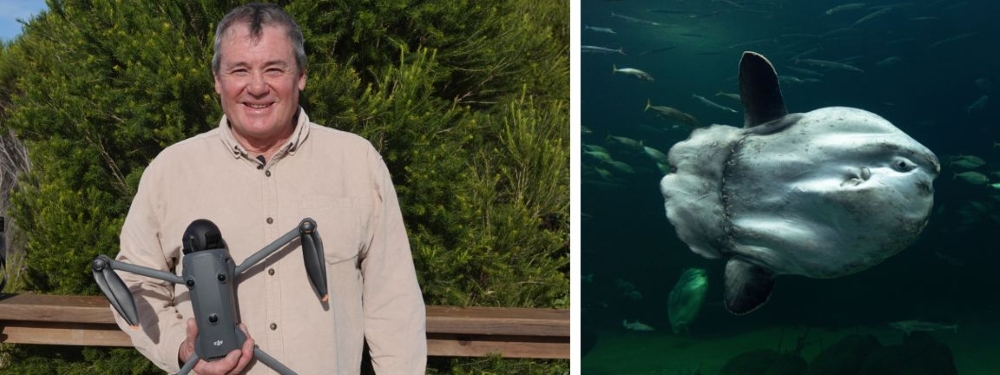
Citizen scientist Terry Dixon filmed a humpback “playing” with a sunfish “the most bizarre animal on the sea”
It’s not the first time scientists have taken notice of Terry’s vision. “In the early days, I didn't realise how significant it was to see whales feeding here off Tathra until the scientists became aware of my footage, and that changed everything. Tathra appears to be a hotspot for whales feeding,” Terry said.
With increasing numbers of people using drones to record whales there are more incidents of feeding in Australian waters being recorded. But Terry was one of the first to reveal this behaviour.
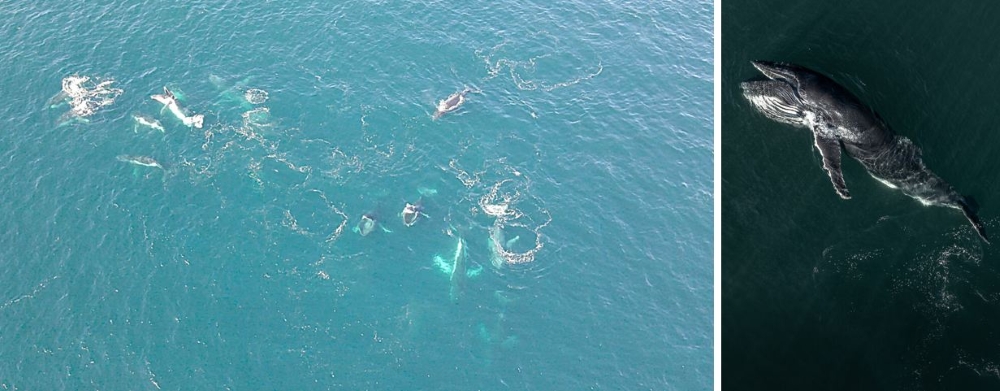
Left: A dozen humpbacks lunge feeding off Tathra © Terry Dixon. Right: A humpback feeding off Warriewood, northern Sydney © Oscar Wuts
“Terry's footage is very significant because it's documenting a new behaviour of feeding within Australia. Humpbacks primarily feed in the Southern Ocean and the Antarctic bulking up to live off those fat reserves. But we know they snack along the way. Documenting that behaviour adds another piece of the puzzle to understand their ecology,” said Chris Johnson, WWF’s global lead on whale and dolphin conservation.
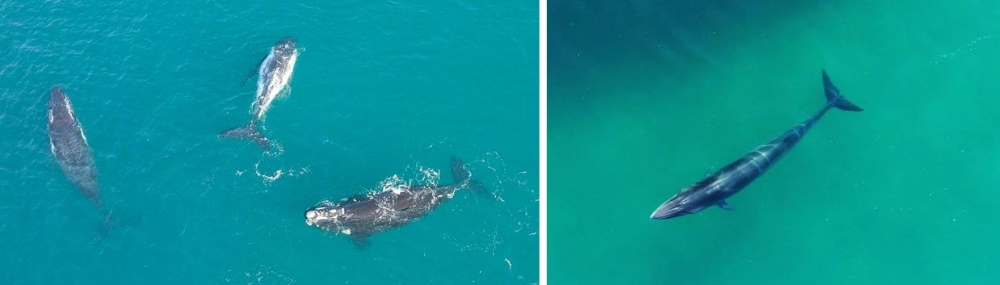
Left: A southern right whale (far right) interacts with two humpback whales. Right: the poorly understood Bryde’s whale © Terry Dixon
Terry’s films are also helping scientists learn more about southern right whales and the poorly understood Bryde’s whale (pronounced Bru-dus). Dr Pirotta led the nation’s first dedicated Bryde's whale study in 2024 and encourages people to report sightings to the Australian Bryde's Whale Catalogue.
There may be fewer than 300 southern rights left in the South East population so every observation is noteworthy. But Terry took it to the next level filming a southern right spending time with two humpbacks.
“You have multi-species interacting with each other, humpback whales and a southern right whale together. I have never seen this. Can they talk to each other? Do they have a chat? These are the kinds of things I'd like to know. It is significant to see this encounter,” Dr Pirotta said.
Increasingly though, Terry is recording whales with injuries caused by humans. For example a humpback with ropes pinning its pectoral fins to its body, a southern right whale mother sliced open by a speed boat, and the famous humpback known as Bladerunner because of propeller injuries along the length of her body.
“Ship strikes are a growing issue. We're seeing scars in whales more regularly worldwide. They're also getting entangled in nets and fishing gear. Over 300,000 whales and dolphins are killed each year as a part of fisheries bycatch,” said Chris Johnson.
With a federal government review of marine parks underway, the World Wide Fund for Nature Australia is calling for 30% of Australia's oceans to be declared sanctuaries free from fishing and mining to provide safe havens for ocean travellers like whales and turtles. Go to https://wwf.org.au/get-involved/marine-sanctuaries/
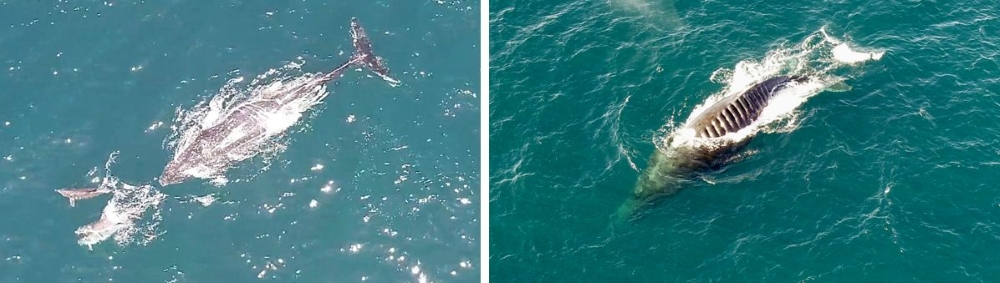
Left: A humpback with rope appearing to pin its pectoral fins to its body. Right: Bladerunner © Terry Dixon
Chris Johnson says more can be done to safeguard whales and points to WWF’s collaboration with partners on the on the Blue Corridors Initiative.
“We need to better conserve and protect the migratory pathways, or 'blue corridors' of whales. We can implement slowdown areas and adjust shipping lanes away from key habitats,” he said.
Robert Cooley, a senior ranger with the Gamay Rangers, agrees with the need for more marine sanctuaries. The Gamay Rangers, headquartered in La Perouse, was the first permanent urban Indigenous ranger team in Australia. They patrol Botany Bay, or Gamay in their language. Humpback whales are central to their creation story.
“Our community has had a connection to Gamay since time began and that continues today. The humpback whale or buriburi is our overarching spirit ancestor or totem. It’s a very significant dreaming story for us,” Robert said.
“We are seeing more humpbacks with injuries from coming into contact with people, ships, fishing lines and shark nets. It is distressing and heightens our desire to keep these animals safe given their significance to us.
“Marine sanctuaries give whales genuine space to do what they do naturally with a lot less risk,” he said.
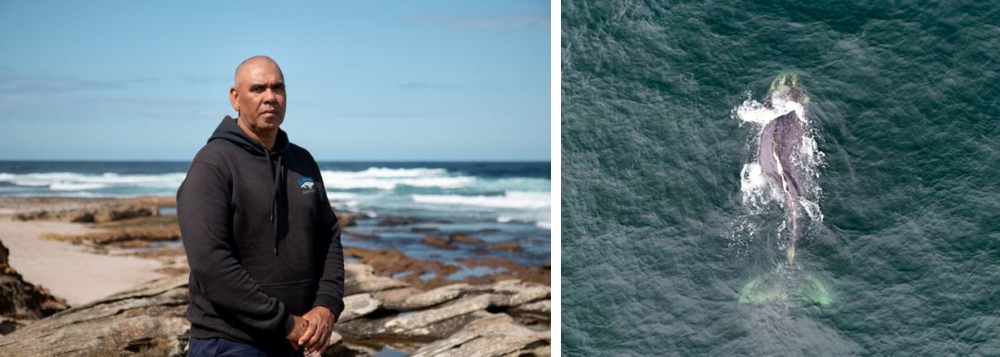
Left: Senior Gamay Ranger Robert Cooley is seeing more humpback whales with injuries. Right: A humpback with a twisted spine possibly caused by a ship collision.
It may be that we need to keep a lookout for whales in Australia for 12 months a year and adjust how we improve their protection.
For the first time, from May 2025 to May 2026, Terry saw humpbacks off Tathra every month of the year.
“I'm convinced some of them just swim up and down this coastline without fully migrating to Antarctica,” he said.
Sightings of humpback whales year-round in Australian waters is something Dr Pirotta continues to monitor.
“Our Pacific partners like New Zealand are also seeing similar things. Is our ocean changing in ways that we're not yet aware of? This is a watch-this-space moment,” she said.
Contact details:
Mark Symons
Senior Media Officer, WWF-Australia
m 0400 985 571
- Images
-
Download
humpback splashes sunfish.jpg
The humpback took aim with its tail then splashed the sunfish multiple times for over an hour © Terry Dixon
