
KTEK Meets Full $10M IPO Target In Under 24 Hours As Insto's Bid For More Than Entire Book
Chapter One Advisors

Highlights
- KTEK's $10 million IPO target was met in under 24 hours, with the raise attracting more than three times the target and institutions bidding for more than the entire book
- Institutional investors are expected to hold ~50% of KTEK’s free float post-listing, with the register including Regal Funds Management (seed and IPO), Thorney Investment Group, VP Capital, Cyan Investment Management and Scopus Ventures alongside TGI Holdings, the Tagliaferro family office
- KTEK to remain strongly founder-led following listing, with Board and Management retaining ~44% of the Company
- KTEK is already commercial - revenue has grown more than 300% over the past two financial years, with FY2025 revenue exceeding A$5 million
- KTEK is a Tier-2 defence supplier of composite airframes and electromechanical assemblies for military UAVs, leveraging a scalable, asset-light global model
- Expected ASX listing: Monday, 18 May 2026 at 11:00am AEST (ASX: KTK)
KTEK Aerosystems Ltd (ASX: KTK) is pleased to announce that its $10 million initial public offering (IPO) met its full subscription target in under 24 hours, ultimately attracting more than $30 million in investor bids - a 3x oversubscription - ahead of its proposed listing on the Australian Securities Exchange on Monday, 18 May 2026.
The demand was driven overwhelmingly by institutional investors, reflecting growing conviction among sophisticated capital allocators that the global defence UAV supply chain represents one of the most compelling structural growth opportunities in markets today. Institutional investors are expected to hold approximately 50% of KTEK’s free float following listing, providing the Company with a strong, high-quality register from the outset.
Among other well-known institutional investors, the raise was anchored by Regal Funds Management, which participated in both the seed and IPO rounds via its Emerging Companies Fund, alongside Thorney Investment Group, VP Capital, Cyan Investment Management and US-Israeli based defence and technology focused fund Scopus Ventures. The Tagliaferro family also participated via its family office, TGI Holdings, adding one of Australia's most recognised investment names to an already high-quality register.
Importantly, KTEK will remain strongly founder-led following listing, with Board and Management to retain approximately 44% of the Company following the IPO. The substantial retained ownership positions ensure strong alignment between management and shareholders as KTEK executes its next phase of growth
TGI Holdings Founder, Anton Tagliaferro, said:
“KTEK is very well-positioned as a picks-and-shovels play to help facilitate the rapid acceleration in drone production driven by strong demand from Defence departments globally. In the US alone, the Department of War is forecasting that its annual drone annual purchases will increase from 50,000 in 2025 to 300,000 in 2026 and then to over a million drones over the next few years.
“As such, KTEK represents a compelling opportunity for investors to gain exposure to this strongly growing sector and to invest in a company that is already demonstrating commercial traction. The strong level of institutional support for the IPO reflects the strong prospects for the company in the years ahead.”
KTEK Managing Director and Founder, Dekel Keisar, said:
"Meeting a $10 million raise target in under 24 hours, with $30 million in total demand, tells you something about where institutional investors see the defence UAV market heading - and KTEK's place in it. Having grown revenue more than 300% over the past two years, we are now focussed on execution - scaling production, onboarding new Tier-1 customers and cementing our position within global defence supply chains."
The IPO was priced at A$0.20 per share, with 140 million shares on issue, implying a pro-forma market capitalisation of A$28 million at listing. The Company is targeting ASX listing on Monday, 18 May 2026 at 11:00am AEST under the ticker KTK. The offer was led by CPS Capital Group’s Nathan Barbarich as Lead Manager and Corporate Advisor.
The KTEK Business: “picks and shovels” supplier into the defence ecosystem
KTEK delivers full-turnkey (FTK) sub-assemblies for military UAVs, integrating mechanical, electrical and firmware components into “ship-ready” systems for Tier-1 and Tier-2 defence contractors. The Company operates an asset-light “Cordless Factory” model, retaining engineering and quality control in-house while leveraging a global network of certified manufacturing partners. KTEK manufactures:
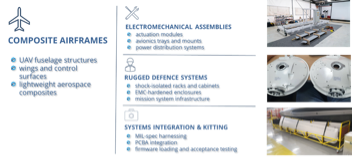
Positioned as a “picks and shovels” supplier into the defence ecosystem, KTEK benefits from structural tailwinds in global military spending and UAV adoption, enabling it to supply leading OEMs without the complexity of direct government contracting.
KTEK has grown revenue by more than 300% over the past two financial years, with FY2025 revenue exceeding A$5 million and production capacity expanding approximately threefold since late 2025. The Company continues to onboard new Tier-1 customers, with multiple supplier approvals secured and initial purchase orders expected.
Funds raised under the IPO will be used to accelerate production scaling, invest in tooling and manufacturing capability, and support the onboarding of new defence customers globally.
What KTEK Actually Does - A Plain-English Explanation
The defence drone industry has a structure that most retail investors don’t think about and understanding it is the key to understanding why KTEK is interesting.
Start With the Drone Supply Chain
When a military buys a drone - whether it’s a surveillance UAV, a loitering munition, or a multi-mission platform - the drone doesn’t come from a single factory where one company builds everything from scratch. Modern military UAVs are highly complex systems, and their production mirrors the same supply-chain logic that underpins the commercial aviation industry.
At the top of the chain are the Tier-1 OEMs (Original Equipment Manufacturers) - the companies that hold the government contracts, design the overall platforms, and are responsible for delivery to the military customer. Think of companies like Elbit Systems, UVision, Textron, or L3Harris. These are the names on the contract.
Below them sit Tier-2 suppliers - companies that manufacture specific sub-systems, components, or assemblies to the OEM’s specifications. The OEM buys these components and integrates them into the final platform.
KTEK is a Tier-2 supplier. It manufactures composite airframes (the structural body and wings of the drone, made from advanced composite materials including carbon fibre and fibreglass), electromechanical assemblies (integrated systems combining mechanical components with electronics such as control surfaces, avionics mounting trays, power distribution modules, and landing gear mechanisms), full-turnkey (FTK) sub-assemblies that are ship-ready and plug directly into the customer’s integration process, and military-spec ground systems supporting UAV operations in the field.
The phrase “full-turnkey” is important. KTEK doesn’t just supply parts - it supplies finished systems that are tested, documented, and ready for integration. This is a higher-value proposition than a simple component supplier and creates genuine switching costs once a customer is embedded.
The “Picks and Shovels” Principle
The phrase “picks and shovels” comes from the California Gold Rush of the 1840s. The most reliable way to make money during a gold rush isn’t necessarily to look for gold - it’s to sell picks and shovels to everyone who is looking. The prospectors take the exploration risk; the tool suppliers get paid regardless of who finds gold.
KTEK’s positioning in the defence drone market follows exactly this logic. The Company doesn’t need to design a drone platform, win a government contract, or navigate the complex defence procurement process. It supplies sub-systems and assemblies to the OEMs who have already done all of that. When a Tier-1 OEM wins a major drone contract, KTEK benefits from being an embedded supplier to that program - without carrying any of the contract risk directly.
The “Cordless Factory”: Why KTEK’s Model Is Genuinely Different
The single most important thing to understand about KTEK is its manufacturing model - because it is what enables the Company to grow rapidly without the capital intensity that would typically be required.
In a traditional defence manufacturing business, scaling production requires scaling the factory. More contracts mean more machinery, more floor space, more workers, and more capital expenditure. The fixed-cost base grows with the business, and the company needs significant upfront investment to win the next tranche of work.
KTEK’s model inverts this. The Company retains in-house control of the two most valuable elements of the business: engineering and design (the technical knowledge of how to build complex military-grade UAV sub-systems to aerospace specifications), and quality assurance and logistics (the systems and processes that ensure every component delivered meets the military-grade standards the customer requires).
The physical manufacturing - machining, composite layup, assembly, and fabrication - is outsourced to a network of certified aerospace manufacturing partners across Israel, Europe, Thailand, and progressively the United States. These partners are qualified to produce components to KTEK’s specifications and under KTEK’s quality management system.
The result: when KTEK wins a new customer or a new program expands, the Company scales through its partner network rather than building new factory capacity. Capital expenditure is modest. Lead times to scale are short. The Company can respond to demand without the typical capital constraints of a defence manufacturer. By distributing production across multiple countries, KTEK also reduces single-point supply chain risk - if one production site faces disruption, production can be redirected to another. Importantly, the same model extends beyond defence - KTEK already counts agricultural and delivery drone operators among its customers, and management believes the commercial UAV market represents a total addressable opportunity larger than the military segment, adding a further growth dimension that is largely independent of defence budget cycles.
The “Embedded Supplier” Advantage
KTEK isn’t a transactional vendor that quotes on each job separately - it is integrated into its customers’ production programs, often from early design stages. Embedded supplier relationships in aerospace and defence have high switching costs: once a customer’s program is designed around KTEK’s sub-system specifications, changing suppliers requires re-engineering, re-qualification, and re-testing - a process that can take months and cost significant money. This gives KTEK a degree of revenue visibility and stickiness that is unusual for a company at its stage.
KTEK Board Overview
KTEK is led by Founder and Managing Director Dekel Keisar, a defence engineer with hands-on experience across more than 20 military UAV platforms. As former Head of UAV Structural Engineering at Israeli Aerospace Industries - one of the world's leading defence and aerospace companies - Keisar brings rare depth in the engineering disciplines that sit at the core of KTEK's business.
The Board has been assembled with a specific focus on scaling defence technology businesses within global UAV supply chains. Chairman Howard Digby brings a track record in exactly this space - as a founding Non-Executive Director of Elsight Ltd, he was part of the team that scaled a defence-focused drone communications company from an ~$18 million ASX IPO to a ~$1.5 billion market capitalisation. Director Chris Baxter adds operational UAV sector intelligence, including advisory roles with leading drone OEM Skyeton and direct exposure to the Ukrainian defence market - currently the most active real-world testing environment for military UAV technology in the world.
Contact details:
David Tasker
Chapter One Advisors
(m) +61 433 112 936
(e) [email protected]
- Images
-
Download
KTEK Image(1).jpg
Managing director and founder of KTEK Aerospace Dekal Keisar (centre), with KTEK executives Ron Halevi (left) and Eyal Epstein (right).
