Stronger export markets accommodate record Australian beef production
Rabobank

With ongoing increases in cattle slaughter and high carcass weights, Australia’s 2025 beef production is set to break new ground with record volumes, according to a new report by agribusiness banking specialist Rabobank.
Beef exports though are also up for the year – and will potentially also reach record levels – well and truly accommodating the increased supply.
In its Q4 2025 Global Beef Quarterly, the bank’s RaboResearch division estimates 2025 Australian production will be approximately 2.9 million metric tonnes, an 11 per cent increase on 2024 volumes and a new record.
Along with increasing production, beef exports have also increased, up 15 per cent for the first 10 months of 2025 to 1.3 million metric tonnes shipped weight.
Report lead author, RaboResearch senior animal proteins analyst Angus Gidley-Baird said the United States remains the largest market, accounting for 29 per cent of Australian beef exports.
“While the majority (96 per cent) of exports to the United States are grassfed beef and largely lean trimmings, grainfed beef exports to the US have increased 20 per cent for the first 10 months of 2025 to 14,000 metric tonnes,” he said.
Mr Gidley-Baird said volumes to China have lifted substantially (up 44 per cent) for the first 10 months of 2025 with a strong increase in grainfed beef exports to China, up 58 per cent. “This is most likely supported by reduced volumes of US beef being exported to China,” he said.
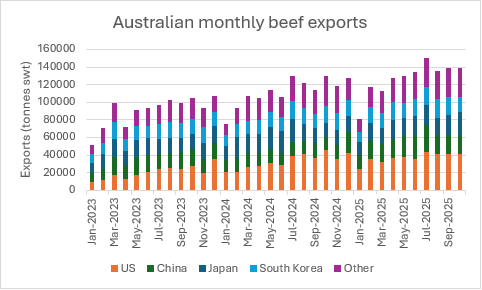
Source: DAFF, RaboResearch 2025
Seasonal conditions
Mr Gidley-Baird said seasonal conditions are the key current driver of the Australian cattle market.
“With a relatively balanced cattle market, Australia's cattle prices are heavily contingent on seasonal conditions and producer sentiment,” he said.
“With no strong underlying rebuilding or liquidation of the herd, producers buying and selling appetite is heavily influenced by seasonal conditions. After drier conditions affected cattle-producing areas through September and into October, cattle prices eased throughout October.
“More favourable rainfall in late October saw prices lift again. This trend is expected to continue through to the end of 2025 and into 2026.”
Global production
“Globally,” Mr Gidley-Baird said, “beef production is declining, as cattle prices increase or remain near record highs.”
Beef production in key producing and consuming regions is expected to contract by 0.8 per cent in 2025, compared to 2024 volumes.
“New Zealand is expected to experience the largest percentage drop in production, down 4.7 per cent (34,000 metric tonnes) while the United States, with its larger production base, is expected to see the largest drop in volume, falling almost 500,000 metric tonnes (down four per cent),” Mr Gidley-Baird said.
“Canada and the EU27+UK are also expected to see a contraction of 3.9 per cent and three per cent respectively (50,000 metric tonnes and 225,000 metric tonnes).”
This contraction reflects an approximate 410,000 metric tonne reduction in global beef supplies compared to 2024 volumes.
On the growth side, Mr Gidley-Baird said, Australia is forecast to see an 11 per cent increase in beef production volumes in 2025, given higher cattle inventory, while China appears on track for one per cent growth fuelled by higher culling in the first half of the year. Meanwhile Brazil is forecast to achieve growth of 0.5 per cent in beef volumes in 2025, following the larger-than-expected production in the first half of the year.
“Globally, beef production in 2026 is expected to see the contraction continue with an estimated drop of 3.1 per cent (down 1.5 million metric tonnes). Key regions where production is set to decline include Brazil, United States, Mexico and Canada,” he said.
Global prices
The Rabobank report found northern hemisphere cattle prices remained elevated in comparison to the southern hemisphere, although US and Canadian prices did contract slightly through September and into October.
Mr Gidley-Baird said this may be more a result of seasonal conditions rather than any increase in supply, with production volumes still forecast to contract further. “Southern hemisphere cattle prices all edged higher through September and October – with the exception of Argentina – as southern cattle supplies are being drawn on to supply northern hemisphere markets,” he said.
Mr Gidley-Baird said decisions by the US administration on trade policy continued to influence beef trade.
“Argentina’s increased quota into the US will allow for greater volumes of beef at lower tariff rates, but Argentinian production volumes will take time to increase. At the same time, the decision in mid-November to remove the reciprocal tariffs on beef trade is not expected to create any trade advantage for any single supplier,” he said.
“And the decision to remove the additional 40 per cent tariff on Brazilian beef in late November is expected to see an increase in Brazilian product sent to the US and will create additional competitive pressures for Australian exports. However, with strong US demand, we still believe Australian exports to the US will remain high.”
<ends>
RaboResearch Disclaimer: Please refer to Australian RaboResearch disclaimer here
Media contacts:
Denise Shaw Will Banks
Media Relations Media Relations
Rabobank Australia & New Zealand Rabobank Australia
Phone: 02 8115 2744 or 0439 603 525 Phone: 0418 216 103
Email: [email protected] Email: [email protected]
About us:
Rabobank Australia & New Zealand Group is a part of the international Rabobank Group, the world’s leading specialist in food and agribusiness banking. Rabobank has more than 125 years’ experience providing customised banking and finance solutions to businesses involved in all aspects of food and agribusiness. Rabobank is structured as a cooperative and operates in 38 countries, servicing the needs of more than nine million clients worldwide through a network of more than 1000 offices and branches. Rabobank Australia & New Zealand Group is one of Australasia’s leading agricultural lenders and a significant provider of business and corporate banking and financial services to the region’s food and agribusiness sector. The bank has 87 branches throughout Australia and New Zealand.
- Images
-
Download
Rabobank_Angus Gidley-Baird_.jpg
RaboResearch senior animal proteins analyst Angus Gidley-Baird.
