T&E Report: Renewable Energy Giant, Fossil-Fuel Skies: Australia's Aviation Sector Lags Behind Its Own Climate Ambitions
T&E

New 2026 Airport Tracker data reveals Asia-Pacific accounts for 32% of global aviation CO₂ — more than Latin America, the Middle East, and Africa combined
SYDNEY--BUSINESS WIRE--
Australia has positioned itself as a committed player in the global net-zero transition. But new data released today raises urgent questions about one of its fastest-growing sources of emissions. Sydney Kingsford Smith Airport generated 8.2 million tonnes of CO₂ in 2023 — more than seven times the total greenhouse gas emissions of the entire city of Stockholm.
This press release features multimedia. View the full release here: https://www.businesswire.com/news/home/20260515941815/en/
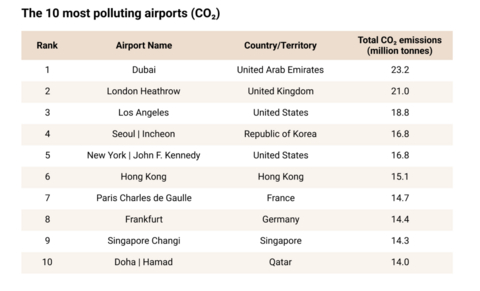
Top airports ranked by total CO₂ emissions (Image: T&E)
The findings come from the 2026 Airport Tracker, published today by ODI Global in partnership with T&E (Transport & Environment), and are based on data provided by the ICCT. The tracker covers 1,300 airports worldwide and reveals that Asia-Pacific has overtaken all other regions to become the largest contributor to aviation emissions, accounting for 32% of global aviation CO₂ — more than Latin America, the Middle East, and Africa combined. Globally, just 100 airports are responsible for approximately two-thirds of total passenger flight emissions. Furthermore, fewer than 2.3% of airports have a credible net-zero Scope 3 emissions plan — the category covering over 90% of an airport's actual climate footprint.
Jude Lee, Regional Policy and Program Director, APAC, T&E (Transport & Environment), said,"Australia is one of the world's most heavily reliant nations on long-haul aviation — and at the same time, one of the most exposed to global fuel price shocks. Australia has the potential to scale up green e-fuel and e-hydrogen production, backed by its ambition to reach 80% renewable energy by 2030. Yet an integrated net-zero blueprint that connects aviation, energy, and industrial transition remains missing. Decarbonising aviation is not just a climate issue — it is a question of Australia's energy security and economic resilience."
Sam Pickard, Research Associate, ODI Global, said,"Since the Paris Agreement, aviation emissions have risen steadily while other sectors have begun to decarbonise. A genuine strategy that includes demand management is sorely needed."
Denise Auclair, Head of Travel Smart Campaign, T&E, said,"It's high time to align airport capacity with our climate, air quality and noise protection goals — and prioritise citizens' health over unchecked expansion."
Attached: Policy Brief Airports and aviationemissions.pdf
View source version on businesswire.com: https://www.businesswire.com/news/home/20260515941815/en/
Contact details:
Crains for T&E
[email protected]

